Explainer · Last checked 7 November 2026
Garment GUI: the touchscreen woven into a sleeve
A garment GUI is a touchscreen built into clothing: fibres woven into the fabric both light up as pixels and sense touch. The term comes from a Nature paper published on 21 October 2026 by a team at the National University of Singapore (NUS).
Their sleeve uses 54 of these fibres. Together they make a 96 × 54-pixel colour screen that plays video at 30 frames per second and still works after 50 machine washes. It is a lab prototype. You cannot buy one yet.1
What the garment GUI sleeve can do
NUS describes a sleeve that behaves like an early smartphone screen on your forearm.1
- Screen: 96 × 54 pixels, 168 mm × 105 mm, 8-bit colour, 30 frames per second.
- Touch: it registers finger presses, including several at once.
- Apps shown in the demo: calculator, photo gallery, video, compass, voice commands, and images received over Bluetooth.
- Sensors: microphone, speaker, motion, magnetic north, temperature and ambient light. Under the arm, it can read and show body temperature.
- Fabric behaviour: as breathable as cotton, polyester and denim, according to the team.
How the garment GUI works
The trick is putting thousands of tiny chips inside a thread.1
- A laser exposes connection points along thin insulated wires, exactly where each microchip needs one.
- Molten solder bonds only at those points. The team joined more than 5,000 chips through more than 20,000 connections.
- The strip of digital LEDs is then drawn into a multilayer fibre with heat. The result is about 1 mm thick and 10 m long.
- A layer under the LEDs senses touch. Pressing the fibre completes a circuit, and the nearest pixel lights up.
- Each fibre has its own control channel. If one line fails, the others keep working.
The team says thinner fibres made the same way could be knitted, woven and embroidered on standard industrial machines.1 That is a claim about the future, not something shown yet.
What it cannot do yet
- It is not self-contained. The prototype uses separate microcontroller circuits wired to the fibres, plus external battery packs.3
- It is low resolution. 96 × 54 pixels is closer to an old phone display than a modern one.
- No product exists. No price, ship date, licence or spin-off company was announced by NUS or reported by The Register.1,3
Our estimate, not a fact: a garment GUI you can buy in a shop is likely five or more years away. Google's much simpler touch-fabric jacket shipped in 2017 and was switched off in 2023. See the tracker for that story.
How it compares with earlier smart fabric
| Project | Year | Shows images? | Senses touch? | Stage |
|---|---|---|---|---|
| NUS garment GUI | 2026 | Yes, 96 × 54 colour | Yes | Lab prototype |
| Fudan University display textile | 2021 | Yes, 6 m × 25 cm | Paired with a textile keyboard | Lab prototype |
| MIT fibre computer | 2025 | No | Senses the body | Lab prototype |
| Google Jacquard (Levi's jacket) | 2017 | No | Yes, taps and swipes | Shipped, then shut down in 2023 |
Dates, details and links for each one are on the garment GUI tracker.
Can you build something like it today?
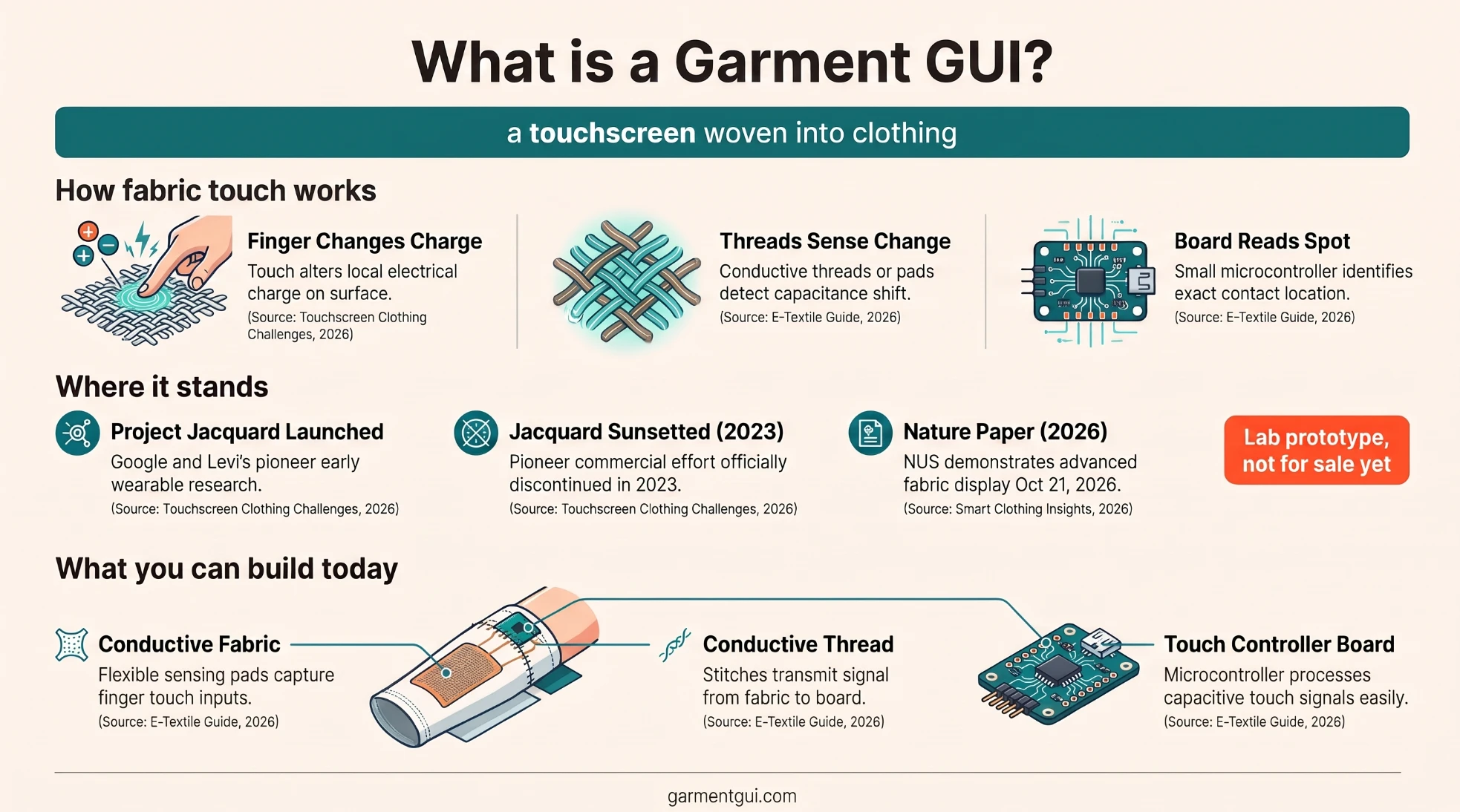
You can build the touch half. Conductive fabric, conductive thread and a capacitive touch board turn a sleeve into a set of touch pads. You cannot build the display half at home yet.
Get the touch sleeve kit: $129 Board, fabric and thread in one box, with our free guide.
Garment GUI FAQ
- What is a garment GUI?
- A touchscreen built into clothing. The name comes from the NUS paper "Touch-sensing digital pixel fibre enables interactive garment GUI", published in Nature on 21 October 2026.2
- Can I buy one?
- No. As of 7 November 2026 it is a lab prototype with no announced product.
- Is it washable?
- The team reports light output and touch response were nearly unchanged after 50 detergent washes in a typical washing machine, and after 1,000 bends around a 5 mm radius.1
- Does it need a battery or a phone?
- It needs power. The prototype uses external battery packs and separate controller circuits.3 It can receive images over Bluetooth, but the demo apps run on the garment system itself.1
- Who made it?
- A team led by Assistant Professor Tural Khudiyev, Department of Materials Science and Engineering, NUS College of Design and Engineering.1
- What could it be used for?
- The team names healthcare first: clothing that collects body data and lets you read it on your sleeve.1
Sources
- NUS News, "NUS researchers thread the world's first touchscreen into a garment", 22 October 2026. news.nus.edu.sg/worlds-first-touchscreen-in-garment
- Nature, "Touch-sensing digital pixel fibre enables interactive garment GUI", 21 October 2026, doi:10.1038/s41586-026-11128-9. nature.com/articles/s41586-026-11128-9
- The Register, "Singapore boffins weave a GUI into fabric, and it's machine washable too", 22 October 2026. theregister.com